Custom Software Development
Your business outgrew
Off-the-shelf software never quite fits, so somebody ends up being the integration: retyping numbers, chasing day sheets, keeping the real version in their own file. We build the missing piece so nobody has to.
What we commit to
We can't show you a logo wall. Here's what we'll commit to instead.
Fixed price per phase
Agreed in writing before work starts. It doesn't move mid-phase.
You talk to the people writing the code
No account managers, no requirements relayed through two layers of process.
A demo every Friday
You redirect us while it's still cheap to redirect. Nothing gets revealed at the end.
Every phase is a stopping point
Each one ends with something your team can use. You decide whether there's a next one.
You own all of it
Your repository, your hosting, standard tooling. No proprietary framework holding you hostage.
We will tell you if we cannot help
The discovery call ends with an honest answer, including no.
Example build
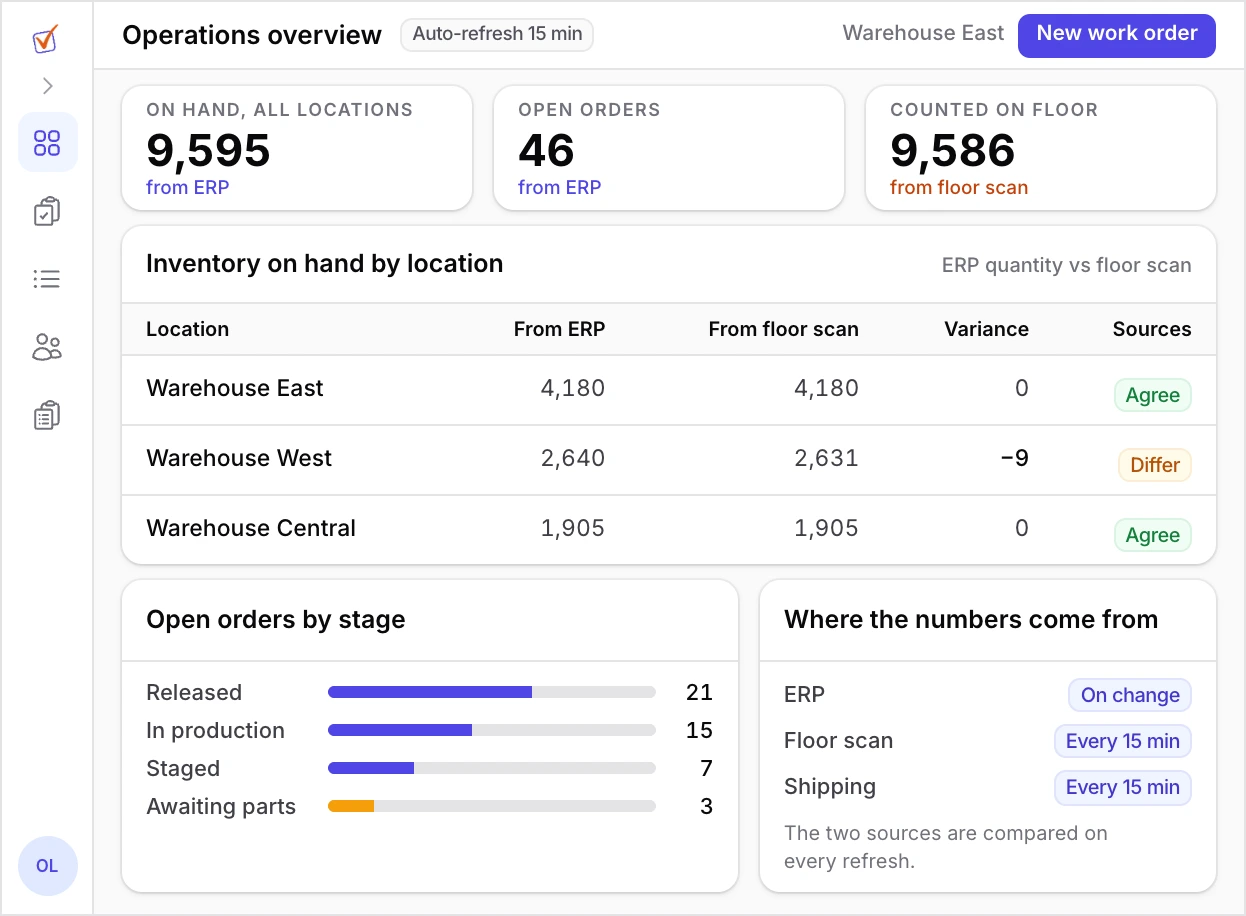
Every number in one place, refreshed on its own.
Your ERP has the data. Your spreadsheet has the version people actually use. We connect them so the number on the screen is the number on the floor, with no morning reconciliation and no emailing the file around.
Example build
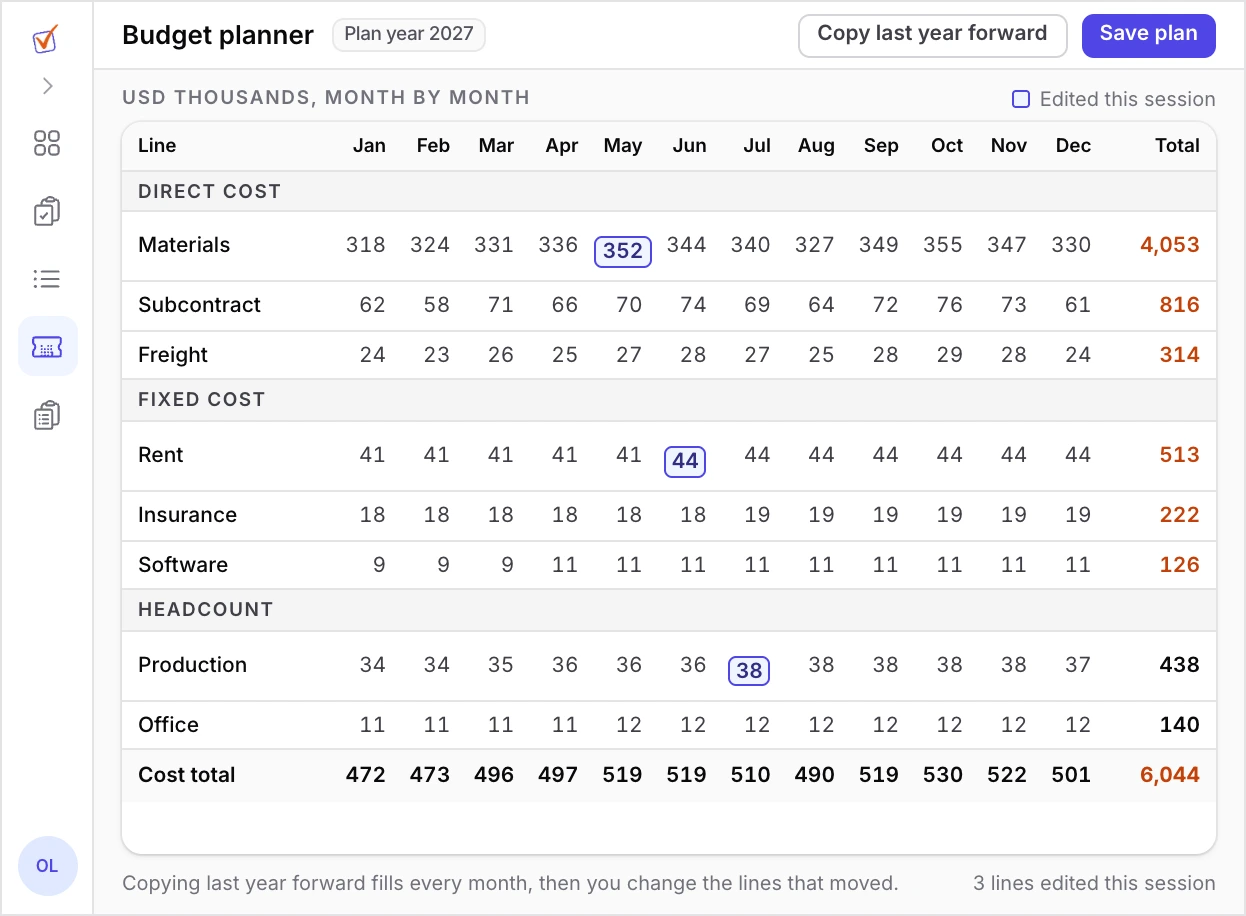
See the whole year before you commit to it.
Direct cost, fixed cost and headcount in one grid, month by month. Copy last year forward, change the three lines that moved, and stop rebuilding the workbook every January.
What we build
Three ways the work usually takes shape
Web Applications
Built so one screen answers the question your team currently calls three people to answer.
Integrations & APIs
Built so the number on the dashboard is the number on the floor, without anyone retyping it.
Mobile Apps
Built to keep working with no signal, and to reconcile itself the moment the phone finds one.
Industries
The problems we build for
These are the problems we build for most often. Whether or not yours is on this list, the industry matters less than the shape of the bottleneck: wherever a person is acting as the integration between two systems, the work is the same.
Manufacturing
All our production data lives in spreadsheets that nobody updates on time, and we only find quality problems after the batch is done.
Distribution & wholesale
Our inventory count is never right, orders fall through the cracks weekly, and suppliers call constantly asking about their payments.
Field services
Our techs call the office five times a day for job details, paper work orders disappear constantly, and we never know who's finished until they drive back.
Construction
Every job has its own spreadsheet, day sheets from the crew arrive a week late, and we only learn a project lost money once it's closed.
The alternative
The other route costs an order of magnitude more and takes a year to find out if it worked.
The conventional answer to an operations problem is a full system replacement. In the businesses we've worked in, that means a budget in the hundreds of thousands, a rollout measured in quarters, and a single moment at the end where you learn whether it fits. We do the opposite. One bottleneck, one phase, four figures to low five figures, and a working deliverable in two to six weeks. If it doesn't help, you stop, and you keep what was built.
Calculator
What the manual work costs you now
Move the sliders. This describes your current state, not anything we're promising to change.
Your numbers
What the manual work costs you now
At the rate you entered
Per month
(Manual hours + error hours) × 52 weeks, priced at the hourly cost you set. Your numbers, your assumptions. This is an estimate to argue with, not a quote. We have no idea yet whether we can reduce it, and we'll tell you in writing if we can't.
FAQ
Common questions
If yours isn't here, ask it. No pressure, no jargon.
Work is priced per phase, not per project. A phase lands in the four figures to low five figures depending on scope. The price is fixed before the phase starts and doesn't move. Most engagements run two to four phases, and each one is approved and funded separately, so you decide after every phase whether to continue. The exact number comes after the discovery call, in writing. We don't publish a single number because a number without scope is meaningless, and the scope depends on what breaks in your process.
Simpler projects take 2 to 6 weeks, usually a single phase. Others run several months, stretched across multiple phases. The timeline for each phase is in the written proposal, before you approve it.
Yes. The people who built it are the people who maintain it, on a monthly arrangement agreed before handover. If you'd rather maintain it in house, you own the code and we'll hand over what your developer needs.
That's the normal case. Most people arrive with a problem, not a solution. The first call is about the process and where it breaks, and it ends with our honest read on which part is worth fixing first, or whether software is the wrong answer.
You own 100% of your code. No proprietary frameworks, no hostage situations: standard tooling, your repository, your hosting.
A scoped piece of work, two to six weeks of development, that addresses one defined bottleneck and ends with a working deliverable your team owns. Not a vague initiative that needs three more iterations before it's useful. Each phase is planned, funded and approved separately, so you keep control of cost and scope and there are no unpredicted financial or technical blowouts.
Straight answers
What we are not going to do
Show you case studies we cannot back up
Most of our past work was either delivered under contract terms that don't allow it, or delivered as a subcontractor where the client relationship wasn't ours to describe. We'd rather say that than invent a percentage.
Quote a price before we understand the problem
Any number we gave you today would be a guess dressed up as a proposal.
Sell you a platform
If a tool you already own can do it, we'll tell you, and we won't charge you to hear it.
Disappear after launch
The people who built it are the people who maintain it.
Ready to fix one thing fast?
Tell us what's breaking. You get a written answer within 24 hours, and if it makes sense we'll set up thirty minutes to map it.